

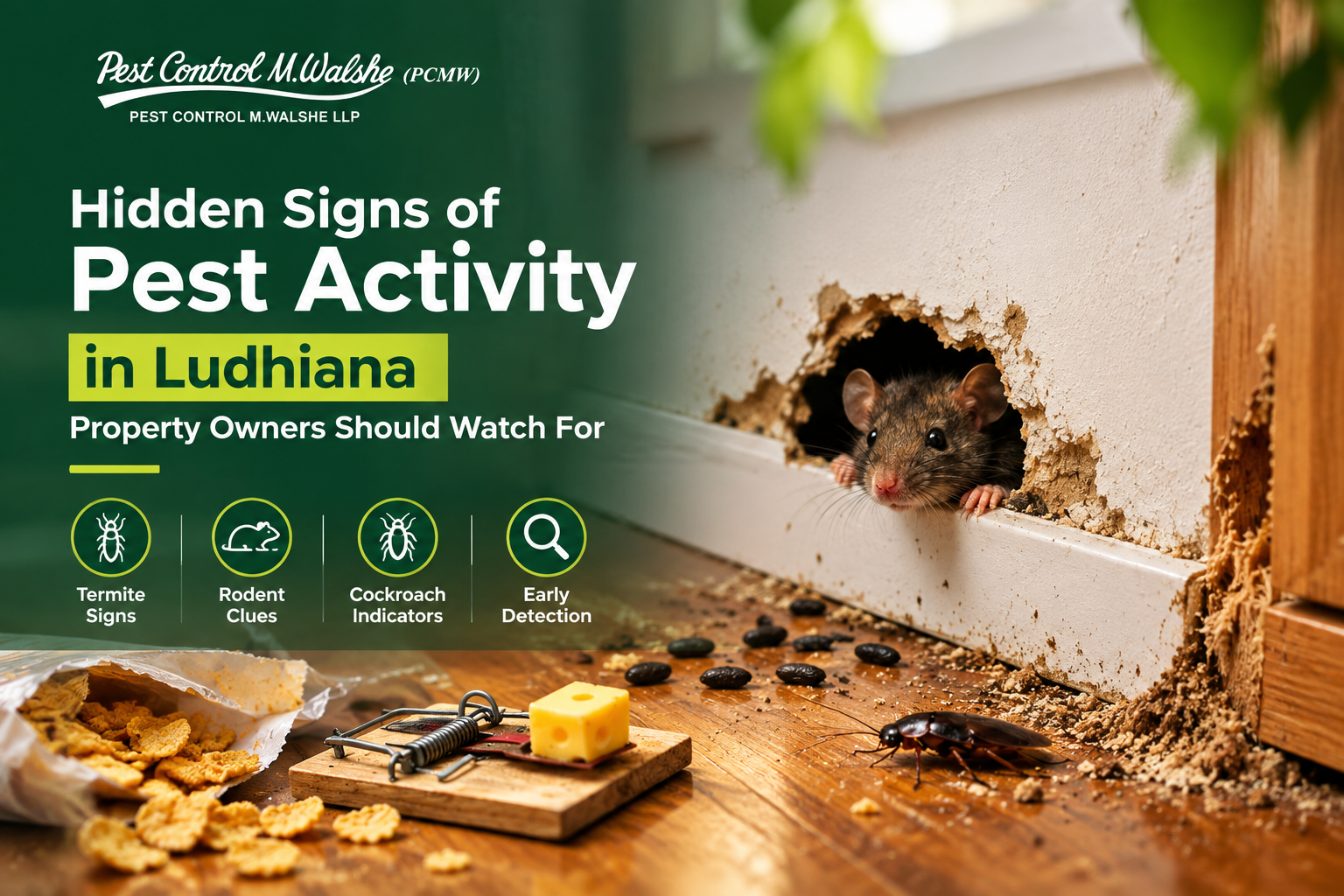
Objective
To help homeowners, shopkeepers, factory managers and warehouse operators in Ludhiana recognise pest problems in the early stage, when treatment is cheaper, faster and far less disruptive.
Key Takeaways
- Most infestations are visible weeks before you see a live pest. The clues are mud tubes, fine wood dust, droppings, rub marks on walls and a musty smell.
- India loses roughly 10% of its food grain after harvest, with insects and rodents doing much of that damage. For Ludhiana’s warehouses and grain stores, early detection is money saved.
- Termites announce themselves through hollow-sounding wood, bubbling paint and mud tunnels along skirting, not by appearing in the open.
- Rodents leave gnaw marks, greasy rub marks and droppings near walls long before anyone spots a rat.
- Monsoon months, roughly July to September, push activity up sharply across Punjab. Inspect more often in this window.
- PCMW has run pest management and fumigation in India since 1956 and works across Ludhiana from Focal Point, Gill Road and Sherpur to Model Town and Sarabha Nagar.
A shopkeeper in Gill Road noticed his wooden shelf sagging slightly. He pushed it back, added a nail, and forgot about it. Four months later the whole unit collapsed with the stock on it. Termites had eaten the inside of every plank while the outer surface stayed smooth.
That is how most infestations work here. The signs of pest activity in Ludhiana properties are usually there for weeks, sometimes months, before anyone sees a live insect or rodent. Government figures put post-harvest losses in India at around 10% of total food grains, with storage insects and rodents responsible for a large share of that, worth thousands of crores every year.
You do not need a technician’s eye to catch a problem early. You need to know where to look and what a small mark on a wall actually means.
Why Do Pest Problems Stay Hidden for So Long?
Pests avoid open, lit, busy spaces. They live inside wall cavities, under floor tiles, behind kitchen platforms, inside cardboard cartons and in the gaps behind machinery, which is exactly where nobody cleans.
By the time a cockroach walks across your kitchen at 10 pm, the colony behind the sink is already established. By the time you see a rat, its family has been running along your wall line for weeks.
There is a second reason. Damage in the early stage looks like ordinary wear. Bubbling paint gets blamed on seepage. A hole in a jute sack gets blamed on handling. Fine powder near a door frame gets swept away as dust. These are pest warning signs, and each one is a chance to act before the cost multiplies.
What Are the Earliest Termite Clues in a Ludhiana Property?
Termites in Punjab work silently inside wood and rarely come into the open. Look for mud tubes, hollow-sounding timber and paint that lifts in small blisters.
Termites, called white ants locally, build mud tunnels to travel between soil and wood without exposure to air.
Signs on walls and skirting
- Thin mud lines running up plaster, skirting boards or along the back of almirahs
- Paint that bubbles or ripples in small patches, with no water source nearby
- Small piles of soil-like grit at the base of a wall that reappear after cleaning
Signs in furniture and door frames
- Wood that sounds hollow when tapped, though the surface looks fine
- Door and window frames that feel soft or spongy near the floor
- Tiny mud-packed holes in plywood backs, drawer bases and shelf undersides
Signs after rain
- Discarded wings on window sills, near tube lights or in the balcony after an evening shower
- Swarming activity around lights, usually a sign that a mature colony is nearby
Ground-floor properties in Dugri, Model Town and Civil Lines see this often because the soil is in constant contact with the plinth. Once wings appear, the colony is not new. It is mature enough to reproduce.
How Do You Know Rodents Are Already Inside?
Rodents leave a clear trail. Droppings near walls, gnaw marks on plastic and wood, and dark greasy smears along the base of walls all point to active movement.
Rats follow the same route every night, and their fur leaves oil behind.
What to look for
- Droppings: dark, rice-grain sized, usually clustered near food storage, behind cupboards or in store rooms.
- Rub marks: greasy grey-black streaks along skirting, pipes and door bottoms.
- Gnaw marks: fresh chew damage on wire insulation, plastic pipes, wooden doors and packaging corners.
- Sound: scratching or scurrying inside false ceilings and wall cavities, mostly at night.
- Smell: a sharp ammonia-like odour from urine in enclosed storerooms.
- Nests: shredded paper, cloth scraps or plastic tucked behind heavy furniture and machinery.
Chewed wiring is the one to take seriously. In Ludhiana’s industrial units, rodent damage to control panels and machine wiring causes shutdowns and fire risk. If a technician tells you a machine failed because of “a rat cut”, the problem started long before that day.
These are early signs of pest infestation worth acting on the same week you see them.
Which Cockroach and Crawling Insect Clues Get Missed?
Cockroaches reveal themselves through droppings, egg cases and smell, not sightings. A musty, oily odour in a closed kitchen usually means a heavy population.
Common missed clues
- Egg cases (ootheca): small, brown, capsule-shaped shells stuck behind hinges, in drawer corners and under the sink
- Droppings: black specks that look like pepper or ink marks, found on shelf edges and inside cupboards
- Shed skins: pale, papery casings near pipe openings and behind the fridge
- Smell: a stale, slightly sweet odour in kitchens, canteens and restaurant prep areas
Bed bugs have their own set of markers, and hotels, hostels and PG accommodations around Ludhiana see them regularly.
- Small rust-coloured spots on bedsheets and mattress seams
- Dark dotted marks along the piping of the mattress and in bed frame joints
- Bites in a line or small cluster on arms, shoulders or legs, noticed after waking
Ants deserve a mention too. A steady line of ants along a wall is not random. It is a supply route between a nest and a food source, and the nest is usually closer than people expect.
What Should Warehouse and Factory Owners Check?
Commercial properties show damage in the stock before they show it in the building. Check packaging, pallets and the floor line along walls first.
Ludhiana runs on textiles, hosiery, bicycle parts, auto components and food processing. Each one has its own vulnerable point.
In stored grain and food material
- Fine powder or dust at the bottom of sacks and bins
- Webbing or clumping in grain, a moth indicator
- Small exit holes in kernels and pulses
- Sacks that feel lighter than they should
In textile and hosiery storage
- Irregular holes in fabric rolls, particularly in stock that has been sitting for months
- Insect casings in folds and along shelving joints
- Discolouration or staining that is not from moisture
In wooden pallets and packing material
- Round exit holes with powder beneath, the standard wood borer signature
- Pallets that split under normal load
- Damage that appears only on the faces resting against the floor
Around the building
- Gaps under shutter doors wider than a pencil
- Drain openings without mesh
- Vegetation touching the outer wall
- Cartons stacked flush against walls, which removes your only inspection lane
For exporters, this matters beyond damage. Live pests in a consignment can mean rejection at port, and a consignment turned back costs far more than an inspection. This is where pheromone monitoring earns its place, catching stored product insects at a population level you cannot see by eye.
Which Season Makes Pest Activity Worse in Punjab?
Monsoon, roughly July to September, is the peak. Heat before it and humidity during it speed up breeding for almost every common pest.
- Summer (April to June): cockroaches, ants and flies increase. Rodents move indoors toward water.
- Monsoon (July to September): termite swarming, mosquito breeding, fungal growth in stored grain, general surge in crawling insects.
- Post-monsoon (October to November): stored grain pests peak as fresh harvest enters warehouses.
- Winter (December to February): rodents move deeper into buildings for warmth and often chew into insulated spaces.
Inspect monthly in normal months. Inspect fortnightly during monsoon, especially in ground-floor storage and any area where water collects.
Quick reference: sign, likely pest, where to look
| What you see | Likely pest | Where to check |
| Mud tubes on walls | Termites | Skirting, wall corners, behind almirahs |
| Fine wood powder | Wood borer / termite | Under furniture, door frames, pallets |
| Dark grease smears | Rodents | Along skirting, pipe runs, door bottoms |
| Rice-grain droppings | Rats or mice | Store rooms, near food, behind machines |
| Black pepper-like specks | Cockroaches | Kitchen cupboards, under sink, behind fridge |
| Rust spots on bedding | Bed bugs | Mattress seams, bed frame joints |
| Discarded wings | Termites | Window sills, balconies, near lights |
| Webbing in grain | Stored product moths | Sacks, bins, silo surfaces |
| Chewed wire insulation | Rodents | Control panels, false ceilings, wiring ducts |
Print this and keep it with your housekeeping checklist. Most hidden signs of pest activity fall into one of nine rows.
Have You Seen Any of These on Your Property? Get It Checked Before It Spreads.
An inspection costs you an hour. A collapsed shelf, a rejected export consignment or a burnt control panel costs far more.
PCMW has worked in pest management and fumigation since 1956 and was the first ISO 9001 certified pest control and fumigation company in India. The Ludhiana team operates from Focal Point and covers homes, shops, factories and warehouses across the city, with same-day service available and government-approved chemicals only.
Every treatment runs through the same five steps: inspection, treatment plan, execution, monitoring and certification. The “No Cure, No Pay” policy means the result is on us.
Book a free inspection: call 0161 267 7431 or reach the team through our pest control services in ludhiana page.
FAQ’s
How do I know if I have termites without breaking the wall?
Tap the wood. Healthy timber sounds solid. Termite-damaged wood sounds hollow or papery, and often feels slightly soft near the floor. Look for thin mud lines on the wall behind furniture and check window sills for discarded wings after rain. If you find any two of these together, book an inspection rather than trying a hardware-shop spray.
Are droppings enough to confirm an infestation?
Yes, droppings mean current activity. Fresh rodent droppings are dark and soft; old ones are grey and crumble. Clean the area completely, then check the same spot after two days. New droppings confirm the pest is still moving through.
What is the cost of pest control in Ludhiana?
Residential treatments generally start from around ₹1,500, depending on the pest, property size and how far the infestation has spread. Commercial and warehouse work is quoted after a site inspection because area, stock type and compliance needs change the scope. Inspections are free and the quote comes before any work begins.
Can I handle early pest signs myself?
Surface sprays kill what you can see and leave the nest intact. For ants and the occasional fly, home methods are fine. For termites, rodents, bed bugs and stored product insects, treatment has to reach the colony or the entry point, which needs proper equipment and approved chemicals. Partial treatment often scatters a colony and makes the second round harder.
How often should a warehouse in Ludhiana be inspected?
Quarterly as a baseline. Every 3 to 4 months for food grain and perishable storage, or as your FSSAI and export compliance requires. During monsoon, move to monthly checks. Annual maintenance contracts cover scheduled visits and work out cheaper than emergency call-outs
Is pest control safe for children and pets?
Yes, when applied by trained technicians using CIB&RC-approved chemicals. Residential treatments use low-odour, low-toxicity formulations, and surfaces are generally safe once dry, usually 2 to 3 hours. Your technician will give specific instructions for the treatment used.
Don’t wait for the pest to introduce itself
The damage you can see is the last stage, not the first. A mud line on the skirting, a bit of powder near a door frame, a grease mark along the wall: each one is the property telling you something is already living inside it.
Check the nine signs in the table above this weekend. If even one shows up, call PCMW on 0161 267 7431 and get a free inspection booked. Catching the early signs of pest activity in Ludhiana properties costs an hour of your time. Ignoring them costs stock, structure and, in a food or export business, your compliance record.