

Key Takeaways
- Rats can get through an opening slightly wider than half an inch, and mice through one slightly wider than a quarter inch. Seal anything close to those sizes.
- Sealing the building lasts longer than any treatment. Traps and bait remove the rodents already inside, but open gaps let new ones arrive.
- Keep stock off the floor, leave a clear aisle along the walls, cover floor drains and repair leaks.
- Check deliveries when they arrive, walk the site on a fixed schedule and write down what you find.
- Food warehouses face written hygiene rules, so keep dated service records ready for audits.
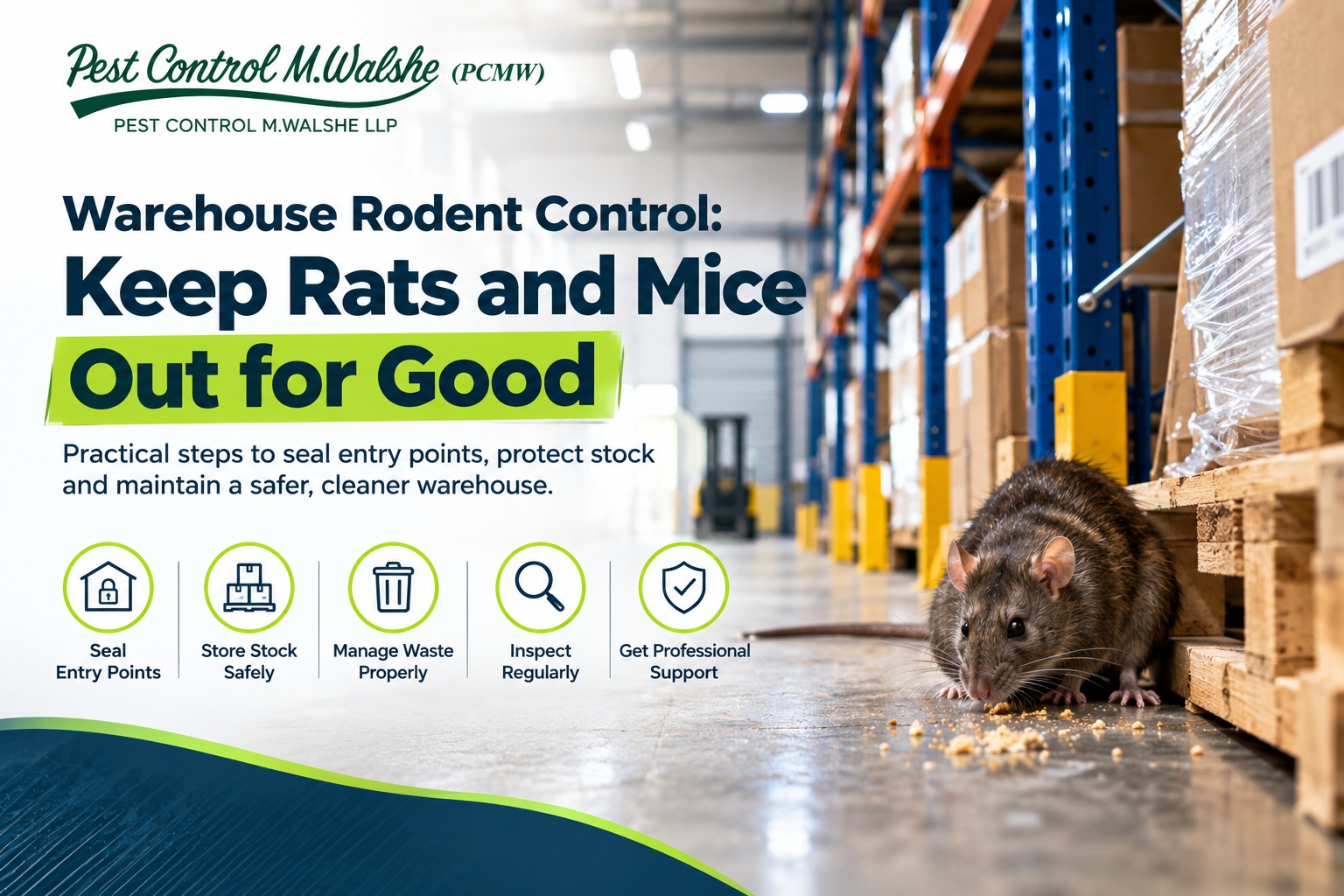
Warehouse rodent control starts with the building, not the bait. Seal the gaps that rats and mice use, take away their food, water and shelter, and inspect the site on a fixed schedule.
The gaps are smaller than most people expect. A University of Nebraska–Lincoln guide on rodent-proof construction states that rats need an opening only slightly wider than half an inch, and mice one slightly wider than a quarter inch. A worn door seal or an open cable entry is enough.
Once inside, rodents find stored goods to eat, packaging to nest in and quiet corners to hide in. They also contaminate food, drink and utensils with urine and droppings, which is how a small problem turns into discarded stock and a failed audit.
At Pest Control M WALSHE LLP, we work with warehouses, godowns and factories. This guide covers the steps that lower the risk, from sealing and storage habits to inspections, and explains when professional help makes sense.
Why Are Warehouses Such Easy Targets for Rats and Mice?
Warehouses give rodents food, shelter and quiet in one place. Stored goods supply the food, gaps behind pallets and racking supply the shelter, and long stretches without foot traffic let them settle in. Large doors, loading bays and drains add several ways inside.
Food is the strongest draw. The Nebraska guide notes that Rodents put more effort into entering buildings where feed is stored, and a warehouse full of packaged food or grain fits that description.
Water is the second draw. Rats need to drink every day, so a dripping pipe, a leaking roof or damp patches near the loading bay can keep them in the building even when the stock is well protected.
The damage goes beyond what they eat. Rats and mice gnaw through cartons and sacks, and they can chew through the rubber or vinyl seals fitted around many warehouse doors. Anything that droppings or urine have touched usually has to be thrown away, and that is where most of the cost sits.
Where Do Rodents Get Into a Warehouse?
Rodents enter through gaps around doors, pipes, cables and vents, through unprotected drains, and inside deliveries. Rats need an opening only slightly wider than half an inch and mice a quarter inch, so small construction gaps deserve more attention than they usually get during a walk-round.
Doors, Docks and Shutters
Check the bottom and sides of every dock door and roller shutter. A gap there is as good as a hole in the wall. Rubber and vinyl seals wear out and can be chewed through, so replace damaged ones instead of simply noting them.
Behaviour matters here as much as repairs. A shutter left open between trips gives rodents a clear path in, so close it whenever loading pauses.
Pipes, Cables, Vents and Drains
Usual weak points as the gaps around pipes, electrical conduits and cables. For vents and windows, it recommends 19-gauge, half-inch hardware cloth to keep out rats and 24-gauge, quarter-inch mesh to keep out mice. Gaps under three-quarters of an inch that cannot be sealed another way can be packed tightly with copper or stainless steel wool.
Choose materials that rodents cannot chew. Foam and soft plastic fail quickly, while metal mesh, steel wool and cement-based fillers last.
Floor drains and expansion joints need the same attention. A drain without a cover, or a joint that has opened along a wall, gives rodents a hidden route into the store.
Deliveries and Pallets
Rodents also travel in with stock. Check incoming pallets and cartons at the receiving bay for droppings, chewed corners and shredded nesting material before anything moves into the main store. Isolate or reject anything that shows signs of activity.
How Should Stock and Waste Be Handled to Reduce Rodent Risk?
Keep stock on racks or pallets off the floor, leave a clear aisle along the walls, clear spills and waste every day, and keep the area outside the building free of stored materials and weeds. These habits remove the food and cover that rodents depend on.
The wall aisle is the habit most warehouses skip. Rodents tend to travel along walls, so a clear strip beside them makes droppings and gnaw marks easy to spot and gives a technician room to place and check traps. Painting the strip a light colour makes droppings stand out even more.
Waste needs the same discipline. Covered bins, emptied daily and kept away from the dock doors, give rodents little reason to stay. Broken packs and spilled products should be cleared within the same shift, because a small spill is enough to feed a mouse.
Outside, stacked pallets, scrap and weeds along the walls give rodents cover on the way in. A clear strip around the building leaves them exposed, and rodents are wary of open ground.
| Area | Habit | Why It Helps |
| Racking and pallets | Keep stock off the floor and away from walls | Removes hiding spots and makes droppings easy to see |
| Wall edges | Leave a clear inspection aisle | Gives access for checks and traps |
| Waste points | Use covered bins and empty them daily | Removes a steady food source |
| Spills and broken packs | Clear them within the same shift | Stops rodents feeding on loose product |
| Loose cardboard and paper | Remove it from corners and the dock | Cuts the nesting material rodents shred |
| Leaks and standing water | Repair them quickly | Removes the water rats need |
| Building exterior | Keep weeds and stored items away from the walls | Removes cover along entry routes |
How Can a Warehouse Spot Rodent Activity Early?
Look for dark pellet droppings, gnaw marks on packaging and wiring, greasy rub marks along walls, shredded nesting material, torn sacks and noises in ceilings or wall gaps, mostly after dark. Check receiving areas, wall edges, the back of racking and drains first, and log every finding.
Rats keep out of sight, so the evidence usually appears before the animal does. Droppings behind equipment, chewed food packets and fresh holes near drains or floor edges are the most common early signs. A musty, sharp smell in a closed store room is another.
No single schedule suits every site. A food or grain store faces more pressure than one holding sealed machine parts. A workable routine is to inspect deliveries on arrival, walk the whole site at set intervals and ask staff to report anything the same day. The written log matters as much as the walk, because it shows whether activity is rising or falling.
How Should Droppings Be Cleaned Up Safely?
Never dry sweep. The same health guidance warns that sweeping dust contaminated with dried rodent urine or droppings can create an infectious aerosol. Wet the area with disinfectant, wear gloves and protective equipment, and follow local health guidance. For large areas, ask a pest control provider to handle the clean-up.
What Does Professional Warehouse Rodent Control Involve?
Professional treatment begins with a site survey to find entry points, travel routes and nesting areas. It then combines outdoor bait stations, indoor traps, proofing advice and follow-up visits, with written records of activity. The aim is a standing programme rather than a single visit.
Large sites do better under a standing programme. A full survey, bait stations and traps on a fixed site map, regular monitoring and written records are what food safety auditors usually ask to see. At Pest Control M WALSHE LLP, our rodent control services follow that approach for warehouses, godowns, factories and cold storage units.
Placement matters. Tamper-resistant bait stations go along outdoor travel routes and near nests, out of reach of children and pets. Indoors, we use traps and glue boards instead of bait, because a rodent that eats bait can die somewhere nobody can reach, which causes odour and attracts other pests. We schedule visits around working hours so operations continue.
Treatment alone will not hold if the building stays open. A good provider will give you a list of gaps, drains and storage habits to fix alongside the treatment, and will check bait uptake and fresh activity on each follow-up visit until the signs stop.
When Should You Call a Professional?
Call when you find droppings in more than one area, when sightings return after you have tidied up, when a food safety audit is coming, or when sealing and trapping have not stopped fresh activity. Calling early also limits how much stock rodents can contaminate.
What Do Food Safety Rules Expect From Warehouses?
Rules vary by country, but they share the same expectations: sealed entry points, covered drains, food stored off the floor and proof that pest control is ongoing. In India, Schedule 4 of the FSS (Licensing and Registration of Food Businesses) Regulations, 2011 sets pest control requirements for licensed food businesses.
Section 9.2 of Schedule 4, titled Pest Control Systems, requires holes, drains and other places where pests can gain access to be kept sealed. It also requires food materials to be stored in pest-proof containers stacked clear of the floor. A guidance sheet from the Delhi food safety department adds a trained service provider and proper documentation to its list of key pest control points.
Requirements depend on your licence category and location, so check the rules that apply to your business. This article is general guidance, not legal advice.
Book a Site Survey for Your Warehouse
If you have found droppings or gnaw marks, or an audit is approaching, a site survey is the sensible first step. Contact our team to arrange one.
Rodent Problems in Your Warehouse?
Protect stored goods, reduce contamination risks and identify hidden entry points with professional warehouse rodent control from PCMW (PEST CONTROL M WALSHE LLP). Get a site survey and a monitoring plan tailored to your facility.
Arrange a Warehouse Site SurveyFAQ's
How Often Should a Warehouse Have Rodent Inspections?
There is no fixed interval. It depends on what the warehouse stores, the condition of the building and the surrounding area. Set the professional visit frequency after a site survey, and expect food and grain stores to need more.
Is Trapping Enough, or Does the Building Need Sealing Too?
Sealing is needed as well. Traps and bait remove rodents already inside, but open gaps let new ones in. Without proofing, treatment becomes a repeat job instead of a fix.
Can Rodent Control Be Carried Out While the Warehouse Is Running?
Usually yes. Outdoor bait stations and indoor traps can be placed around normal activity, and visits can avoid peak shifts. Agree the plan in advance so nothing is applied near exposed food.
Should Staff Clean Up Rodent Droppings Themselves?
Small amounts, yes, but only by wet cleaning with disinfectant and protective equipment. Never dry sweep. For large areas or heavy contamination, hand the job to a pest control provider.
What Pest Control Records Should a Warehouse Keep?
Keep a site map showing bait stations and traps, dated service reports, a log of sightings and a record of the repairs made. Auditors usually ask for these, and they show whether activity is rising or falling.