

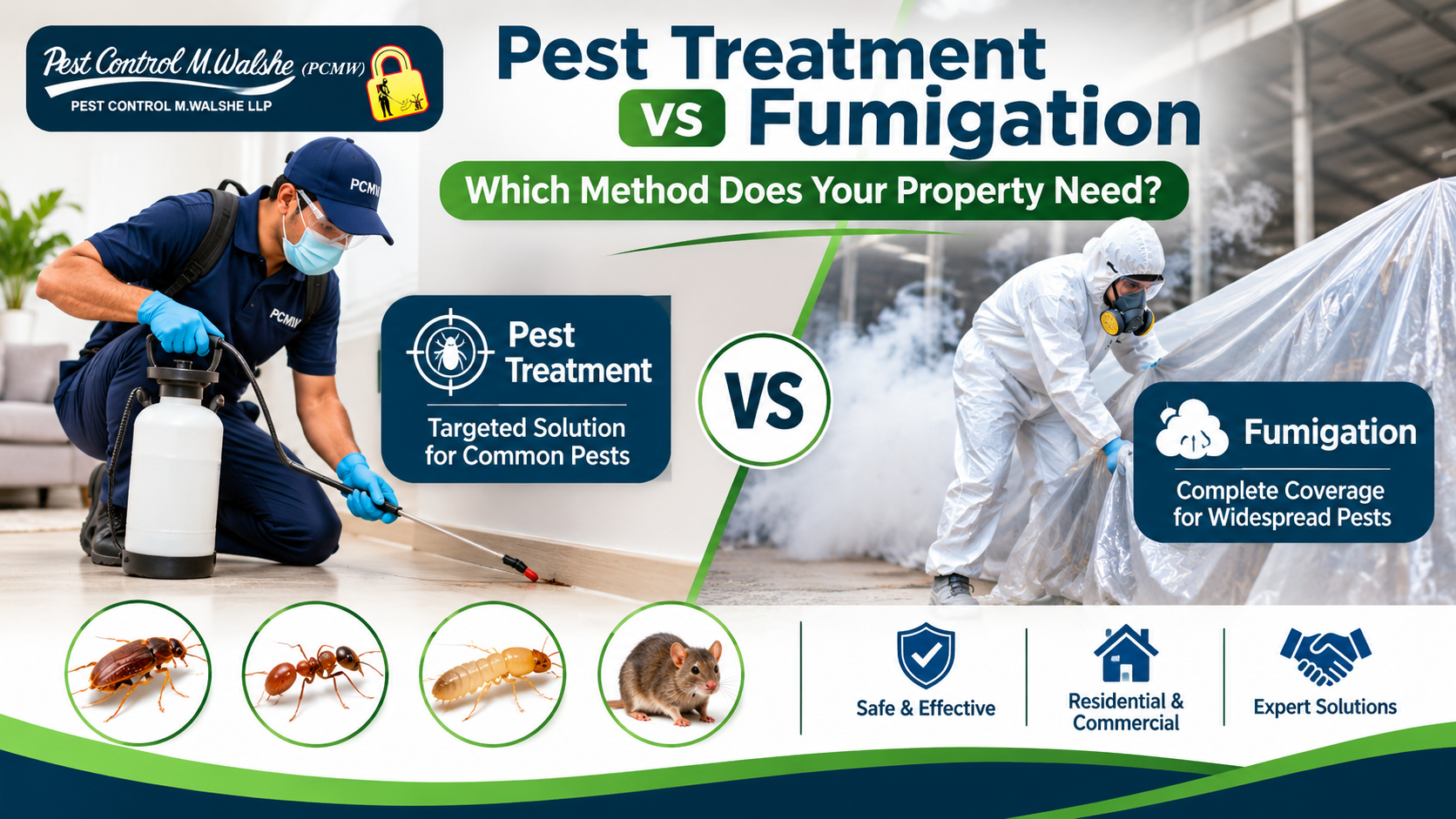
Pest control treats the places where pests live, feed and travel. Fumigation fills a sealed space with gas and reaches every corner. That is the short version of pest treatment vs fumigation, and picking the wrong one means paying twice.
The stakes are bigger than most people expect. The FAO estimates that up to 40 percent of global crop production is lost to plant pests and diseases every year. The same insects move into godowns, containers, factories and homes once the harvest ends.
This blog explains how each method works, where they differ, what drives the cost and how to decide. It draws on the approach of PCMW (Pest Control M. Walshe), which has handled pest management and fumigation in India since 1956.
Key Takeaways
- Pest control is a targeted treatment using sprays, gels, baits, traps and sealing. It suits homes, offices, restaurants and most common infestations.
- Fumigation releases gas into a sealed space for a fixed time. It suits stored grain, export containers, ship holds, factories and hidden, widespread infestations.
- The pest treatment vs fumigation decision comes down to where the pests are and how far they have spread.
- Fumigation leaves no lasting protection, so pests can return. Pest control keeps working between visits.
- Fumigation must be done by licensed professionals, and the space stays empty until it is tested and cleared.
- Unsure? An inspection settles it before you spend anything.
Table of Contents
- What Is Pest Control Treatment and How Does It Work?
- What Is Fumigation and How Does It Work?
- What Is the Difference Between Pest Control and Fumigation?
- Pest Treatment vs Fumigation: Which Method Does Your Property Need?
- How Effective Is Each Method?
- How Much Do Pest Control and Fumigation Cost?
- What Should You Look for in a Pest Control and Fumigation Company?
What Is Pest Control Treatment and How Does It Work?
Pest control treatment is a targeted method. A technician finds where pests live and treats those spots with sprays, gels, baits, traps or physical barriers. Most properties stay in use, or reopen within a few hours.
Here is how a proper visit runs:
- Inspection. The technician identifies the pest, the entry points and the nesting areas.
- Treatment. Chemical, biological or mechanical methods are chosen to suit the pest and the place.
- Exclusion and sanitation. Gaps are sealed, leaks fixed and food sources cleaned up.
- Follow-up and monitoring. Repeat visits confirm the problem is gone and catch it early if it returns.
Example: A restaurant kitchen has German cockroaches behind the dishwasher. The fix is gel bait in the hinge gaps, sealed pipe entries and a second visit two weeks later. Nobody needs to close the kitchen for days.
PCMW organises this work by pest. Its Crawling Protec, Rattus Protec and Termi Protec services cover cockroaches, rodents and termites, and pheromone monitoring tracks activity over time.
What Is Fumigation and How Does It Work?
Fumigation is a treatment where a gas, called a fumigant, is released into a sealed space at a concentration that kills pests. Gas travels where sprays cannot, such as cracks, machinery, wall voids and stacked bags.
The process has four stages:
- Survey and planning. The team measures the space, identifies the pest and picks the fumigant.
- Sealing. Gas-proof sheets and tape close doors, vents and gaps.
- Exposure. The gas stays in for a set period. Depending on the gas, the temperature and what is inside, that runs from about a day to several days.
- Aeration and clearance. The space is ventilated and tested with a gas detector. Nobody re-enters until the reading is safe.
Fact: Fumigants leave no residue, so they give no protection once the gas is gone. That is why goods can be reinfested after treatment, and why prophylactic treatments exist to prevent it.
Fumigation also carries trade weight. Khapra beetle was found in California in 1953, and eradication took until 1966. Countries have been strict about imported goods ever since, which is why PCMW runs ship hold, container, empty hold and stored grain fumigation.
What Is the Difference Between Pest Control and Fumigation?
The difference between pest control and fumigation is reach and method. Pest control treats specific spots. Fumigation treats the entire enclosed space with gas.
| Factor | Pest Control | Fumigation |
| Method | Sprays, gels, baits, traps, sealing | Gas released in a sealed space |
| Reach | Surfaces and targeted areas | The whole space, including hidden voids |
| Common targets | Cockroaches, ants, rodents, termites, flies | Stored grain pests, hidden infestations, quarantine pests |
| Downtime | Usually a few hours | Space stays empty for days |
| Lasting protection | Yes, with residual products | None |
| Done by | Trained technicians | Licensed fumigators only |
| Best for | Homes, offices, hotels, restaurants | Grain, containers, ship holds, factories |
One more term causes confusion. Fogging is not fumigation. Fogging disperses a mist of insecticide, often for mosquitoes, and does not need a sealed space. Fumigation uses gas and does.
Pest Treatment vs Fumigation: Which Method Does Your Property Need?
Choose pest control for most homes, shops and offices. Choose fumigation when pests are hidden, widespread, inside stored goods, or when a regulation or buyer demands it.
Match it to your property:
- Home or apartment: Pest control. Cockroaches, ants, rodents and termites respond to targeted treatment. Whole-home fumigation is rare.
- Restaurant, hotel or hospital: Pest control with regular monitoring. Audits expect records.
- Warehouse or godown: Often both. Fumigation for infested stock, pest control for rodents and building edges.
- Factory or food unit: Fumigation when insects get inside machinery, plus ongoing pest control.
- Export containers, ship holds, wood packaging: Fumigation, since importing countries set the rules.
You likely need fumigation if:
- The infestation keeps returning after proper treatment.
- Pests are inside bagged grain, stored commodities or machinery.
- They sit in places a technician cannot reach.
- A buyer or port authority asks for a fumigation certificate.
Our recommendation: Start with pest control. Move to fumigation when treatment has failed twice, the pests are inside your stock or equipment, or compliance requires it.
How Effective Is Each Method?
Both work when matched to the problem. Fumigation services is highest against hidden, widespread pests, because gas reaches the whole space. Pest control works best on visible, localised infestations.
Where fumigation wins:
- Reaches eggs, larvae and adults when dose and exposure time are right.
- Treats stacked goods, machinery and wall voids in one go.
- Meets export and quarantine requirements.
Where pest control wins:
- Protects the property between visits.
- Needs little or no downtime.
- Handles rodents, termites and crawling insects precisely.
Expert view: Fumigation fails mostly because of poor sealing, low temperatures or the wrong dose. A leaking tarp lets gas out and pests live. This is why it should never be a DIY job.
How Much Do Pest Control and Fumigation Cost?
Fumigation usually costs more per job than a standard pest control visit, but the two are priced differently. Pest control is priced by property size, pest type and number of visits. Fumigation is priced by the volume of space or quantity of goods.
What moves the price:
- Size of the area or tonnage of stock
- Type of pest and severity
- Fumigant and exposure time
- Sealing and preparation work
- Follow-up visits and documentation
Compare the scope, not just the number. A good quote states the area covered, the visits included and the safety clearance. PCMW publishes its fees upfront with no hidden charges, and works on a “No Cure, No Pay” policy.
What Should You Look for in a Pest Control and Fumigation Company?
Look for licensed staff, a written inspection, clear pricing and a post-treatment clearance reading. A company that quotes before inspecting is guessing.
Use this checklist:
- Licensed, trained fumigators
- An on-site inspection before the quote
- A written scope and price
- A safety plan and a gas clearance test
- Certificates and records for audits or exports
- A clear follow-up policy
PCMW was the first ISO 9001 certified pest control and fumigation company in India. Its teams work across major Indian cities, from homes to ports. You can see the full range of fumigation and pest control services on the website.
Not Sure Which Method Your Property Needs?
Get an inspection first. PCMW will look at the pest, the space and your goals, then recommend the method that fits. Call +91-22-22850615, email info@pcmw.com or book online.
The Bottom Line
A pest problem rarely fixes itself, and the wrong fix costs you weeks. The pest treatment vs fumigation question has a simple rule: treat spots with pest control, treat whole sealed spaces and stored goods with fumigation.
Still unsure? Talk to the PCMW team. Call +91-22-22850615 or request an inspection today.
FAQ's
Is fumigation the same as fogging?
No. Fogging sprays a fine insecticide mist, often for mosquitoes and flying insects, and people can return soon after. Fumigation uses gas in a sealed space, and the area stays empty until it is cleared.
How long should I stay out after fumigation?
Until the fumigator tests the air and says it is safe. Exposure runs from about a day to several days, and aeration comes after that. A gas reading decides, not the clock.
Does fumigation kill all pests?
It kills the pests inside the sealed space during treatment, including eggs and larvae when dose and time are right. It does not stop new pests from coming in later. Follow-up pest control and sealed entry points handle that.
How often does a property need pest control?
Rule of thumb: homes need a preventive visit a few times a year. Restaurants, hotels and food units need monthly or fortnightly service with monitoring. Fumigation happens only when needed, such as before export or after stored stock gets infested.
Is fumigation safe for homes with kids and pets?
It is safe when licensed professionals do it. Everyone, pets and plants included, must leave, and food must be removed or sealed. Never try it yourself. For most homes, targeted pest control is the simpler and safer choice.