

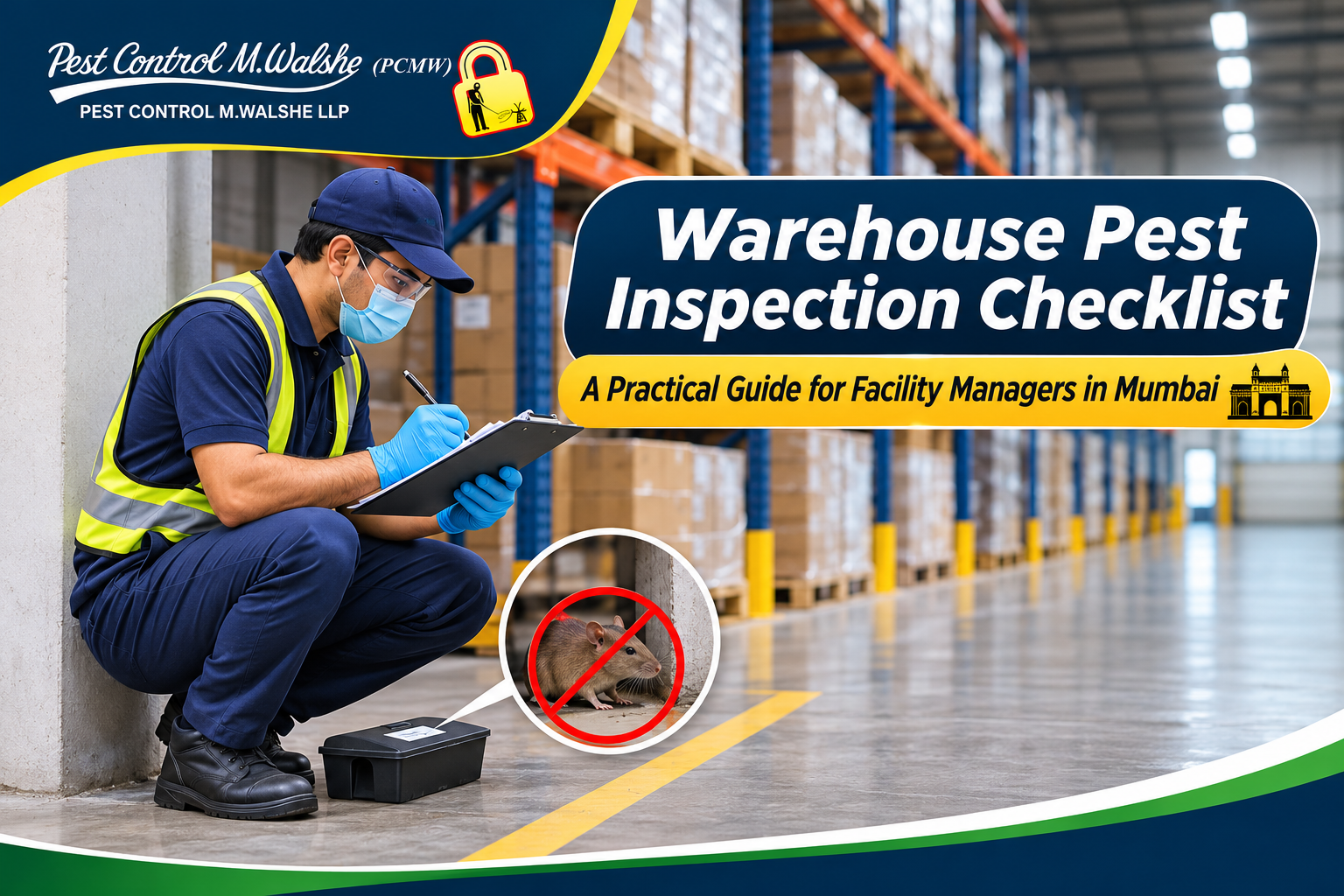
A warehouse passes a pest control audit when its inspections, records and fixes match what is actually on the floor. Most failures come from gaps in that match, not from pests.
The stakes are real. The FAO estimates that 13.3% of the world’s food was lost between harvest and retail in 2023, a stretch that includes storage and wholesale. Pests are one of the reasons stock never reaches the shelf. For facility managers in Mumbai, where humidity is high and the monsoon is long, a simple warehouse pest inspection checklist is the cheapest way to catch them early.
This blog explains what a pest control audit covers, gives you a step-by-step checklist, and shows how to build a prevention plan your auditor will trust.
Key Takeaways
- A warehouse pest control audit checks whether your monitoring, records and corrective actions match what is physically on site.
- Use a warehouse pest inspection checklist that covers six zones: exterior, docks and doors, storage, interior and sanitation, monitoring devices, and paperwork.
- A facility can lose audit points for missing records or a wrong device map, even when no pest is seen.
- Our recommendation: inspect in-house every month, review each service report when it arrives, and run a full audit at least once a year.
- Warehouse pest control in Mumbai needs extra attention from June to September, when humidity and rain push pests indoors.
- A warehouse pest prevention plan built on integrated pest management (IPM) uses sealing, sanitation and monitoring first. Chemicals come last.
- Choose a provider that gives you a device map, trend reports and support on audit day.
What Does a Pest Control Audit for a Warehouse Actually Check?
A warehouse pest control audit checks whether your pest program is documented, active and effective. The auditor compares your paperwork with what they see on the floor.
Auditors usually review five areas:
- Device placement and condition. Are traps, monitors and bait stations where the map says they are, and do they work?
- Service reports and records. Are visit dates, chemicals used and technician licences on file?
- Corrective actions. Who fixed each problem, what did they do, and when?
- Building condition and sanitation. Are there gaps, leaks, waste build-up or poor stacking?
- Trend review. Is anyone actually reading the pest data and acting on it?
Fact: Pest control firms such as Sprague point out that documentation gaps, mismatched device maps and missing corrective action records cost more audit points than live pest sightings do. Orkin adds that pest control can carry a significant share of a facility’s total audit score.
Example: The device map lists 40 bait stations, but only 36 are on the wall. Nobody has seen a rat. The auditor still writes a finding.
An audit and a risk assessment are not the same thing. An audit confirms your current program is running as written. A risk assessment is a deeper review of your site’s specific weak points.
How Often Should You Inspect a Warehouse in Mumbai for Pests?
Walk the site yourself every month, read every service report as it arrives, and run a full audit at least once a year. Increase the pace if you store food, grain or pharma goods, or if you see any activity.
| Check | Who does it | How often |
| Quick floor walk (docks, receiving, waste area) | Warehouse supervisor | Weekly |
| Full inspection using your checklist | Facility manager | Monthly |
| Service visit and device check | Pest control provider | Monthly, or as per risk |
| Report and trend review | Facility manager and provider | After every visit |
| Full audit and plan review | QA team and provider | Yearly, and before any external audit |
Recommendation: Treat the monsoon as your highest-risk season. Mumbai is coastal and humid, and warm, damp conditions suit many stored product pests. Rodents also move indoors when the rain starts. Use your warehouse pest inspection checklist more often from June to September.
The Warehouse Pest Inspection Checklist: What Should Facility Managers Check?
Check six zones in order: exterior, docks and doors, storage areas, interior and sanitation, monitoring devices, and records. Tick each item, note what you find, and give every fix an owner and a date.
1. Exterior and Perimeter
- Weeds, long grass or standing water close to the walls (monsoon puddles count)
- Waste bins, scrap and unused pallets stacked against the building
- Drain covers, vents and pipe entries that are screened and intact
- Burrows, gnaw marks, bird nests and wasp nests
- Bright lights near doors that draw flying insects
2. Docks, Doors and Entry Points
- Door sweeps and seals with no daylight showing
- Doors closed when not in use
- Gaps around pipes, cable ducts and foundations. Guidance for food warehouses suggests sealing any opening larger than about 6 mm (¼ inch)
- Incoming loads and pallets checked before they go into storage
3. Storage Areas and Racking
- Stock lifted off the floor and kept the walls clear. A gap of around 45 cm (18 inches) is common industry practice and lets you inspect behind stacks
- First in, first out rotation, with old or damaged stock set aside
- Spilled product cleaned up straight away
- Signs of activity: gnawed packaging, droppings, webbing, fine powder (frass) and holes in bags
4. Interior Structure, Drains and Waste
- Cracks in walls, floors and ceilings
- Drains that are clean, with no standing water or leaks
- Waste removed daily and bins kept covered
- Staff food stored in sealed containers in break rooms only
- Ceiling voids and light fittings checked for nests
5. Monitoring Devices
- Every device numbered, on the map and in place
- Bait stations locked and intact
- Traps and glue boards checked and replaced
- Pheromone traps read and counts logged. Our pheromone monitoring service tracks moths and beetles this way
- Insect light traps clean and kept away from open product
6. Records and Documents
- Service reports signed and filed
- Chemicals used, with names and doses
- Corrective action log showing owner, date and result
- Staff training records
- Pest control records kept for as long as your standard requires. FSSAI’s hygiene rules expect food businesses to run regular pest control with proper records, so check the current text for retention periods
What Should You Do When You Find Signs of Pests?
Stop handling the affected stock, isolate it, and call your provider the same day. Speed limits the damage.
- Stop and isolate. Pause picking or loading from the affected lot.
- Photograph and record. Note the date, the location and what you saw.
- Call your provider. For droppings, gnaw marks or runways, book warehouse rodent control in Mumbai straight away.
- Find the cause. Look for the gap, the spill or the water source that let them in.
- Log the fix. Record the action and check it again after a week.
How Do You Build a Warehouse Pest Prevention Plan in Mumbai That Passes an Audit?
Write down who inspects what, how often, what counts as a problem and what you will do about it. Then follow it and keep the records. A written warehouse pest prevention plan is the first document most auditors ask for.
Definition: Integrated pest management (IPM) is a method that prevents pests through inspection, sealing and sanitation. It uses chemicals only when they are needed.
Follow these steps:
- Map the site. Mark entry points, storage zones, waste areas and every device.
- Rate the risks. Food, grain and packaging each carry different pest risks.
- Seal and exclude. Fix gaps, doors and drains before you spray anything.
- Set sanitation rules. Cover waste, spills, stacking and stock rotation.
- Plan for the monsoon. Raise the inspection pace and check drainage before the rains arrive.
- Monitor and record. Use devices, read them on schedule and log the counts.
- Define action levels. Decide what number of catches triggers a response.
- Train your team. Staff are your first line of defence, so show them what to report.
Here is what to look for first, by pest:
| Pest | Typical sign | Check first |
| Rodents | Droppings, gnaw marks, smear marks | Dock doors, pipe entries, behind pallets |
| Cockroaches | Live insects, egg cases | Drains, break rooms, warm corners |
| Stored product insects (beetles, weevils, moths) | Webbing, frass, holes in bags | Grain, pulses, spices, old stock |
| Birds | Droppings, nests | Roof edges, open vents, loading bays |
| Termites and wood borers | Mud tubes, fine sawdust | Wooden pallets, door frames, timber supports |
Which Mumbai Warehouses Need the Strictest Pest Audits?
Any warehouse storing food, grain, medicines or export cargo needs the strictest audits. Contamination in these sites can stop shipments and trigger regulatory action. This matters across Mumbai’s warehouse clusters, from Bhiwandi to Navi Mumbai.
- Food and agri warehouses: Grain, pulses and spices attract stored product pests. FSSAI hygiene rules apply.
- Export and import cargo: Containers and wood packaging need treatment before they move. Pest Control M WALSHE LLP offers fumigation for ISPM 15, warehouses, agri and export containers.
- Pharma and cosmetics: Pest contamination can trigger regulatory action in these sectors.
- FMCG and e-commerce fulfilment: Chewed cartons and damaged packaging mean returns and lost sales.
The benefits of regular audits are practical:
- Protects stock before it is damaged
- Reduces the risk of rejected shipments
- Catches problems early, when treatment is smaller and cheaper
- Gives you records to show an auditor at short notice
Rodents are a good example. Research on stored grain shows they cause losses by spoiling products with hair, urine and droppings, not only by eating it.
What Should You Look for in a Pest Control Partner?
Pick a provider that gives you a written plan, a device map, regular trend reports and someone who shows up on audit day. A provider who only sprays is not enough.
Ask these questions:
- Do they follow an IPM approach with a written plan?
- Will they supply a device map and update it?
- Do you get a signed report and a corrective action log after each visit?
- Are the technicians trained and licensed?
- Can they handle rodents, insects and fumigation under one contract?
- Will they support you on audit day?
- Are the fees clear before work starts?
Pest Control M WALSHE LLP (PCMW) has worked since 1956 and describes itself as one of India’s largest and oldest pest management and fumigation companies. Its head office is at Nariman Point, Mumbai. Its approach covers infestation identification, monitoring, sanitation, exclusion, extermination and audit documentation, backed by a “No Cure, No Pay” policy.
You can explore the full range of commercial pest control services in Mumbai for warehouses, factories and export facilities. See the dedicated page for pest control and fumigation services in Mumbai. If you run sites in other cities, PCMW also serves Delhi, Gurgaon, Noida, Ludhiana, Baddi, Chennai and more.
How Much Does a Warehouse Pest Control Audit Cost?
There is no standard price. Cost depends mainly on warehouse size, what you store, pest pressure and visit frequency. Ask for an itemised quote after a site inspection.
Price drivers include:
- Total area and number of floors
- Type of goods stored (food, grain, packaging or general cargo)
- Number of monitoring devices and bait stations
- Visit frequency and any emergency callouts
- Fumigation or specialist treatments
- Reporting and audit-day support
Recommendation: Compare scope, not just price. A cheaper quote with fewer visits and no reports can cost you more at audit time. PCMW states that its fees are published upfront, with no hidden charges.
Not Sure Your Mumbai Warehouse Is Audit-Ready?
Share your layout and storage type with the Pest Control M WALSHE LLP team and get a second pair of eyes before the auditor arrives. Call +91-22-22850615, email info@pcmw.com, or get in touch online.
Walk Your Mumbai Warehouse Before the Auditor Does
Pests rarely announce themselves. A monthly walk with a warehouse pest inspection checklist, a written prevention plan and clean records put you ahead of most audits.
Start with your docks and storage zones this week. Then bring in Pest Control M WALSHE LLP to inspect the rest, fix the gaps and keep your site ready all year. Reach out through the contact page and talk to a team that has been doing this since 1956.
FAQ’s
What does a warehouse pest control audit include?
It includes a walk through the site, a check of every monitoring device, a review of service reports and corrective actions, and a look at sanitation and building condition. The auditor also checks that your paperwork matches what is on the floor.
How often should a warehouse in Mumbai be inspected for pests?
Do a full in-house check every month and a quick walk weekly at docks and receiving. Your provider should visit monthly or as the risk requires. Run a full audit at least once a year, and step up checks during the monsoon.
Can a warehouse fail a pest audit without having pests?
Yes. Missing records, a wrong device map or no corrective action log can all lose points. A clean floor with poor paperwork still looks weak to an auditor.
What pests are common in Mumbai warehouses?
Rodents, cockroaches, stored product insects such as beetles, weevils and moths, and birds. Termites and wood borers can also affect wooden pallets and fittings. Humid coastal conditions make stored product pests and rodents more active during the monsoon.
Does Pest Control M WALSHE LLP provide warehouse pest control in Mumbai?
Yes. The company is headquartered in Mumbai and offers rodent control, insect control, monitoring and fumigation for warehouses and commercial sites. Call or email the team with your site details and they will arrange an inspection.