

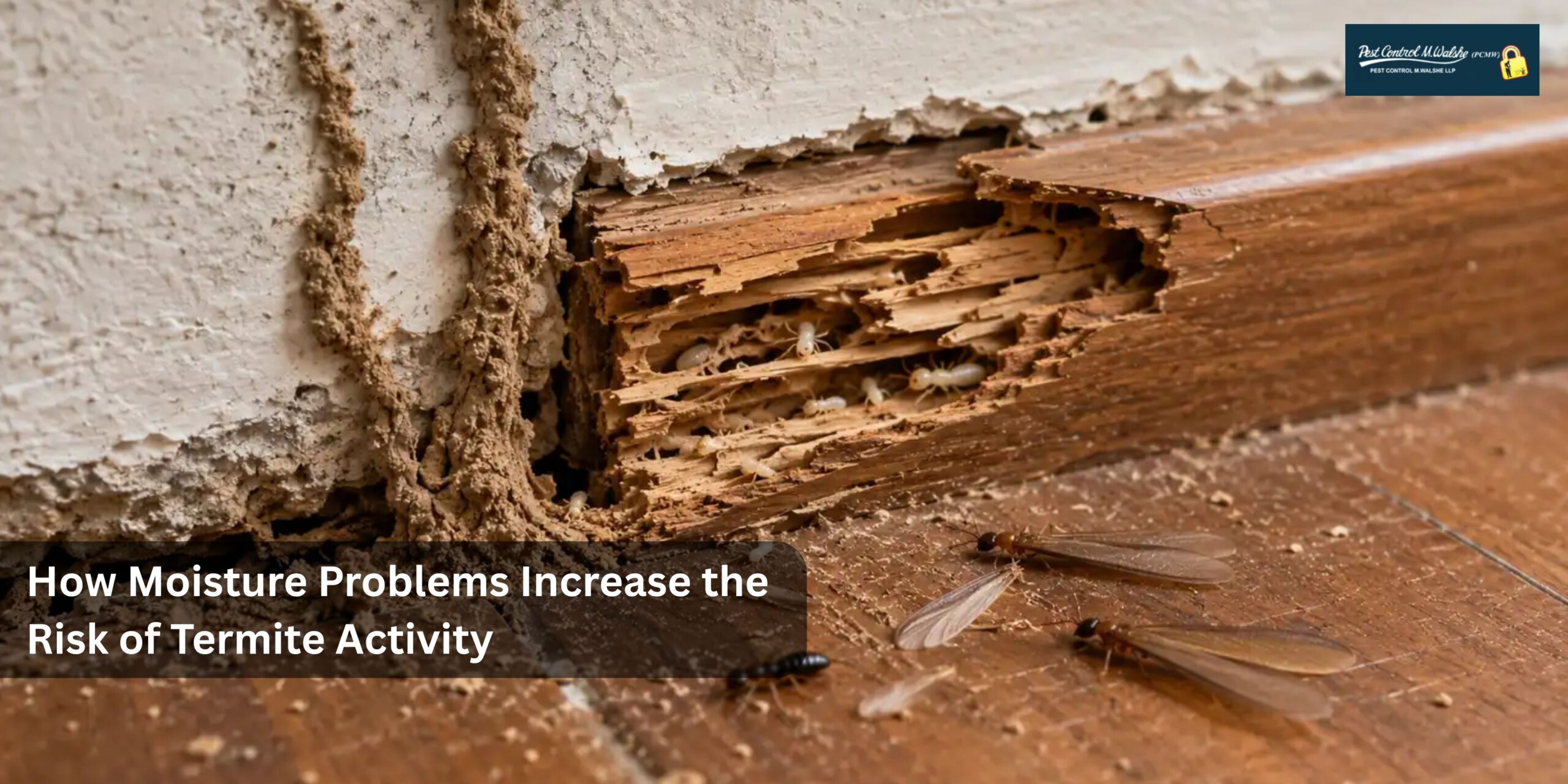
Objective
Explain how excess moisture in and around a property creates conditions that attract termites, and give homeowners practical steps to cut that risk before an infestation starts.
Key Takeaways
- Moisture and termites go together. Damp wood is softer, easier to tunnel through, and closer to the humidity termites need.
- Damp wood termites go after waterlogged or decaying timber, often near a leak nobody’s fixed yet.
- Bathrooms, kitchens, basements, and AC drainage points are where most indoor moisture problems start.
- Fixing leaks, improving airflow, and grading soil away from the foundation are the termite prevention tips that actually hold up over time.
- Termite pest control works better paired with moisture control. On its own, it only solves half the problem.
A client in Pune once called us back a few months after treatment, asking why termites kept showing up in the same corner of his kitchen. We checked. A slow leak had been running under the sink the entire time, and nobody had noticed it.
That’s usually how it goes. Termites need three things: wood, shelter, and water. Most homes already limit the first two without trying. Water is the one that sneaks past everyone, and it’s often the real reason termites come back after a treatment instead of staying gone.
This post covers why moisture and termites tend to show up together, where dampness collects without anyone checking, and what actually keeps both under control.
Moisture and termites are directly linked. Damp, decaying wood is softer and easier for termites to feed on, and it matches the humidity they need to survive. Leaky pipes, poor drainage, and damp basements are common triggers. Fixing those sources alongside professional termite pest control is what keeps an infestation from coming back.
What’s the Link Between Moisture and Termites?
Termites need water to survive, and wet wood is easier for them to digest than dry wood. A leak that sits unfixed for a few months can turn a low-risk area into an active feeding site without anyone realizing it.
Termites lose moisture through their bodies fast, so they stay close to damp spots by instinct, not by chance. A leaking pipe near a wall, a poorly sealed bathroom joint, or a garden bed pushed right up against the foundation gives them shelter and hydration in one place. That’s usually all it takes.
How Does Excess Moisture Attract Termites Indoors?
Wet wood is softer, and high indoor humidity mimics the underground conditions termites already prefer. Framing, subfloors, and furniture near damp areas end up as the easiest targets in the house.
A few common sources we see on inspections:
- Leaking pipes under sinks or inside walls that raise humidity in a closed space
- Bathrooms with poor ventilation, where condensation works its way into wall cavities
- Blocked gutters that send rainwater toward the foundation instead of away from it
- AC units with faulty drainage, leaving damp patches on nearby walls or flooring
- Mulch or garden beds piled directly against exterior walls, trapping ground moisture
One of these by itself might not do much. Add untreated wood nearby, and the risk goes up fast.
What Are Damp Wood Termites and How Are They Different?
Damp wood termites go after wood with high moisture content, usually decaying or water-damaged timber, and they rarely need soil contact the way subterranean termites do.
That’s what makes them tricky. They turn up in places people assume are low-risk, like a water-stained window frame or a deck post that’s been sitting in standing water for a season. If wood feels soft, spongy, or off-color, treat it as a possible target, not a maybe.
Where Does Moisture Build Up Without You Noticing?
Moisture collects fastest in spots that are closed off, poorly ventilated, and rarely checked. That’s exactly why it goes unnoticed until termites or mold force the issue.
- Under kitchen and bathroom sinks. Slow leaks here can run for months before anyone spots them.
- Basements and crawl spaces. Naturally humid, and often the last place anyone inspects.
- Around the window and door frames. Rain seeps in at the base and stays trapped.
- Behind AC units and drain lines. Condensation drips into the nearest wall.
- Along the foundation perimeter. Bad grading sends rainwater back toward the house instead of away from it.
Checking these spots takes an afternoon, twice a year. Skipping it costs a lot more later.
What Termite Prevention Tips Actually Reduce Risk?
The prevention tips that actually work cut off moisture and wood-to-soil contact. Take away either one, and a property becomes a much harder target.
- Fix leaking pipes and taps the moment you notice them, not after they get worse
- Clear gutters regularly and point downspouts away from the foundation
- Grade soil so it slopes away from exterior walls, not toward them
- Ventilate bathrooms, kitchens, and crawl spaces properly
- Keep firewood and untreated timber off the ground and away from the house
- Avoid mulch or dense planting that touches the foundation directly
None of this needs special tools. It just needs to happen regularly, not once a year right before monsoon.
When Should You Call for Termite Pest Control?
Call in professional termite pest control the moment you spot mud tubes, soft or hollow wood, or discarded wings. Waiting to see if the signs go away on their own usually makes the eventual repair bigger.
At PCMW, our Termi Protect service treats active termite activity and flags the moisture-prone spots that let it start in the first place. We’ve handled residential and commercial termite management since 1956, and our “No Cure, No Pay” policy means a job isn’t done until the infestation actually is, not after one round of treatment.
DIY Moisture Fixes vs Professional Termite Pest Control
DIY moisture control lowers the risk, but it won’t remove a colony that’s already established. The two need to work together.
| Approach | What It Solves | What It Misses |
| DIY moisture fixes (leak repair, ventilation, grading) | Reduces the conditions that attract termites | Doesn’t touch an existing colony |
| Professional termite pest control | Treats active infestation, applies soil barriers | Won’t stop new activity if moisture problems stay unfixed |
| Combined approach | Handles current activity and lowers future risk | Needs coordination between homeowner and technician |
Skip either half, and there’s a good chance you’re dealing with the same problem again in a year or two.
Moisture-related termite problems can affect homes, offices, warehouses, and industrial facilities regardless of location. If you’re looking for reliable pest control services in Baddi, PCMW provides customized termite management solutions for residential and industrial properties. We also offer professional pest control services in Gurgaon, helping homeowners and businesses prevent termite infestations through detailed inspections and long-term protection plans. With decades of industry expertise, our pest control services in Mumbai combine advanced termite treatment methods with preventive solutions that safeguard properties from recurring pest problems. Explore our dedicated location pages to find expert pest management services available in your cit
Conclusion
Moisture and termites show up together more often than people expect, and it’s rarely the obvious leak that causes the damage. It’s the slow drip under a sink or the damp corner of a basement nobody checks until the wood starts giving way.
If you’ve noticed dampness near wooden fixtures or flooring, don’t wait for termites to confirm it. Contact PCMW for a moisture and termite risk assessment before either problem gets bigger than it needs to.
FAQs
Can fixing a leak alone get rid of termites?
No. Fixing a leak removes one thing that attracts termites, but a colony that’s already there needs direct treatment. Moisture control works as prevention, not as a cure.
Do termites need standing water to survive?
Not standing water exactly, but they do need steady humidity or contact with damp wood or soil. Even a slow drip or ongoing condensation is enough to keep them active.
How do I know if wood damage is from moisture or from termites?
Water damage tends to warp, stain, or soften wood evenly. Termite damage usually sounds hollow when tapped and shows layered tunneling, sometimes with visible frass, and it can overlap with moisture damage in the same spot.
Are damp wood termites more common in certain climates?
Yes. Coastal and high-humidity regions see more of them, since the surrounding air keeps wood conditions favorable without needing an active leak to trigger it.
How soon after fixing a moisture problem should I get a termite inspection?
As soon as the repair is done, not months later. If termites were already active before the fix, that colony still needs to be dealt with separately.