

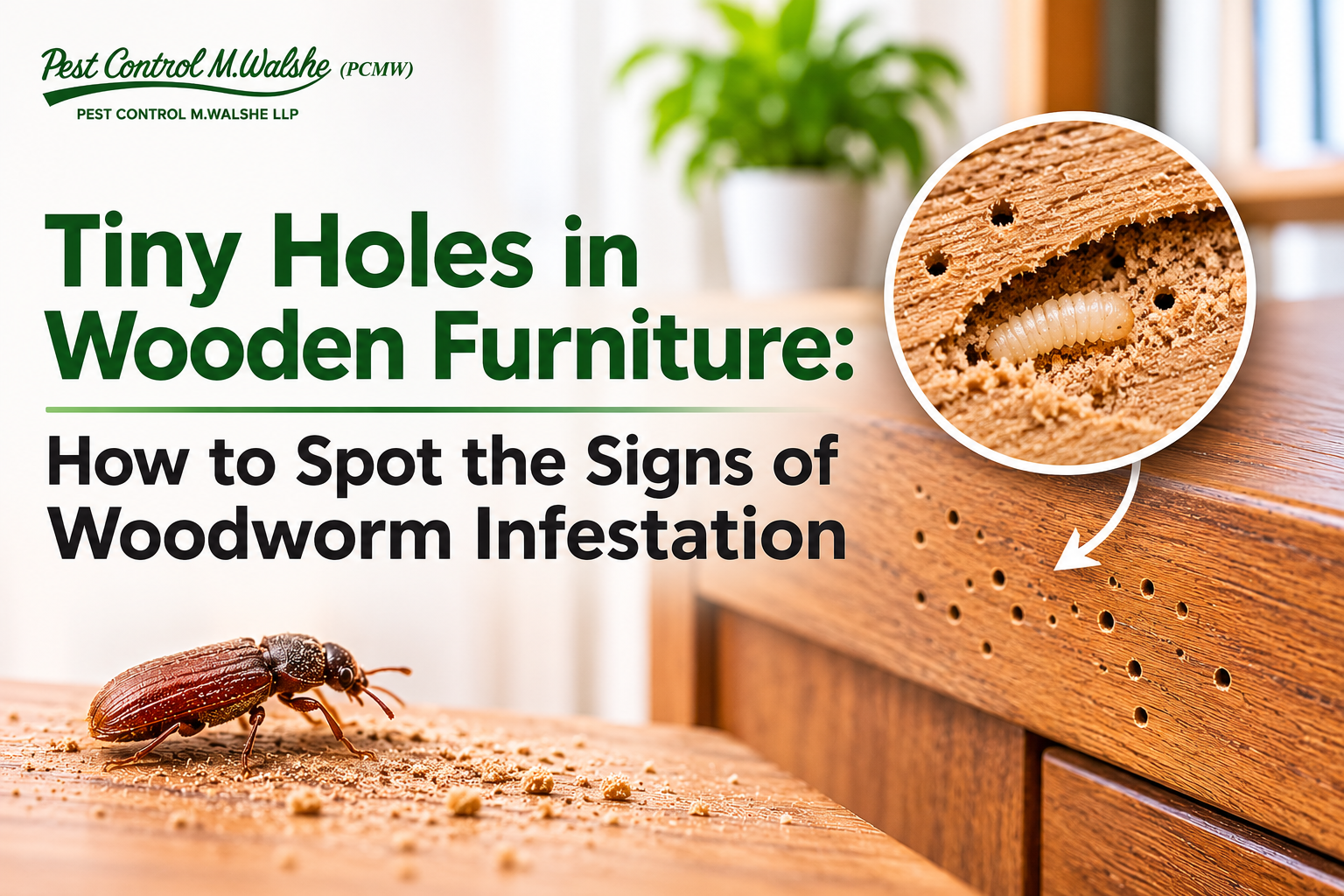
Tiny round holes with fresh, pale powder underneath usually mean wood borers are still alive inside your furniture. These are the clearest signs of woodworm infestation, and they are easy to dismiss until a chair leg or table edge starts to crumble.
Here is a useful fact to keep in mind. Powderpost beetles, the most common furniture borers, leave exit holes only 1/32 to 1/8 of an inch wide, according to University of Maryland Extension. That is about the size of a pinhead, so most people miss the first holes.
This blog explains what the holes mean, how to tell live damage from old damage, and what to do next.
Key Takeaways
- Fresh powder (frass) below small round holes is the strongest sign that borers are active.
- Exit holes are small, usually 1 to 3 mm, and perfectly round.
- Old holes look dark and dusty inside. New holes look clean and pale.
- Sweep the powder away and check again after two to three weeks. If it returns, the infestation is active.
- Termites and wood borers can damage the same property, so check for both.
- Painting or polishing over the holes does not kill larvae already inside the wood.
- Early treatment is cheaper and keeps the furniture intact.
What Are the Signs of Woodworm Infestation in Wooden Furniture?
The main signs of woodworm infestation are small round holes, fine powder below them, and wood that sounds hollow or feels weak. One sign alone can mislead you. Two or three together almost always point to live borders.
Look for these, in order of how reliable they are:
- Fresh frass. This is a fine, sawdust-like powder pushed out of the holes. It collects on the floor or on the shelf below.
- Clean, light-coloured holes. New exit holes show bright wood inside the opening.
- Shot holes in groups. A scatter of holes across a surface, often on the underside or back of a piece.
- A hollow sound. Tap the wood with your knuckle. Solid wood gives a firm sound. Tunnelled wood sounds dull.
- Crumbling or blistered surfaces. Edges and joints break away with light pressure.
- Adult beetles. Small beetles near the furniture during warm months are a late sign.
Check the places people forget: the underside of tables, drawer bottoms, bed frames, and the back panels of wardrobes.
How Does Wood Borer Damage Happen?
Wood borer damage starts when a female beetle lays eggs in cracks or old exit holes in bare timber. The larvae hatch and tunnel through the wood for months, sometimes years. You only see the holes when the adult beetle finally chews its way out.
That delay is the problem. By the time you notice wood-boring insect damage in furniture, the larvae may have been feeding for a long time. Unfinished or lightly finished wood, such as the back of a cupboard, is the easiest place for beetles to lay eggs.
Here is a scenario we see often. A family buys a second-hand almirah or an antique teak chest. Nothing looks wrong for a season. When the weather warms up, a few holes appear and a thin line of powder shows on the floor. The beetles were already inside the wood before it came home.
Warm months bring the main flight period, so signs often appear then. If you live in [City], watch your timber more closely from spring through the monsoon.
Note: Proper warehouse hygiene and preventive measures can help reduce the risk of rodent infestations. Read our guide on how to reduce the risk of infestation in warehouses for practical tips.
How Can You Tell If the Damage Is Active or Old?
Damage is active if fresh powder keeps appearing after you clean it away. Old damage leaves holes but no new powder. The difference decides whether you need treatment or just repair.
What you see | Active infestation | Old damage |
Inside the hole | Bright, clean wood | Dark, dusty, or dirty |
Frass | Fresh, pale, keeps returning | None, or old and compacted |
New holes | Appear over weeks | None appear |
Live beetles | Sometimes present | Not present |
You can run a simple home check. Extension entomologists suggest this method.
- Clean all powder from the furniture and the floor below.
- Mark the area and note the date.
- Check again after two to three weeks.
- If fresh powder has returned, the infestation is active.
For a stricter test, seal the existing holes in a small patch with wax or tape. New holes elsewhere in that patch, appearing months later, confirm live borers.
One caution. Powder can keep falling from old holes when the furniture is moved or vibrates. Fresh powder alone does not prove activity, so use the repeat check before you decide.
If you are unsure about the signs of woodworm infestation in [City] homes or workshops, a trained technician can inspect the piece and tell you quickly.
Is It Woodworm or Termites?
Woodworm leaves small round exit holes and fine powder. Termites usually leave mud tubes and hollow timber with no clear exit holes. The two pests behave differently, and sometimes they share the same building.
Feature | Wood borers | Termites |
Holes | Small, round, clean | Rarely visible |
Powder | Fine frass near holes | Mud, soil, or pellets |
Moisture need | Dry wood is enough | Often need soil or damp |
Typical clue | Shot holes and dust | Mud tubes, papery wood |
Termites often work from inside the wood, which makes hidden termite damage hard to see until the surface collapses. If you notice mud tubes on walls, damage near ground level, or door frames that sound hollow, get the property checked for both pests.
Larger, oval holes point to a different borer, such as the old house borer. That usually means structural timber, not a dresser or a chair.
What Should You Do About Wood-Boring Insect Damage in Furniture?
Isolate the piece, photograph the holes, and call a professional before you try any spray. Quick action stops beetles from moving to nearby wood. Home remedies rarely reach larvae deep inside the timber.
Follow these steps:
- Move the furniture away from other wooden items, if you can do so safely.
- Vacuum the frass and seal the bag outside the house. Wear a mask.
- Take clear photos of the holes and the powder.
- Inspect nearby wood, including floors, door frames, and shelves.
- Avoid polish or paint over the holes. Larvae stay alive underneath, and open exit holes let females lay eggs again.
- Book an inspection. A professional will confirm the species and the spread.
If only one small piece is badly damaged, replacement may be the simplest fix. For anything valuable or widespread, treatment is the better route.
How Does PCMW Treat Wood Borers?
PCMW treats wood borers through an initial inspection, followed by injection and surface spray treatments. For severe infestations, fumigation services may also be used to reach larvae hidden deep inside the wood, helping treat the problem at its source.
Pest Control M. Walshe (PCMW) has worked in pest management and fumigation since 1956 and is the first ISO 9001 certified company in the field in India. Our wood borer control services follow a clear process:
- Inspection: We map which items are affected and how active the infestation is.
- Injection treatment: Insecticide goes directly into exit holes and drilled points, reaching larvae in the tunnels.
- Surface spray: A protective coat on joints and untreated timber stops new beetles from laying eggs.
- Follow-up inspection: We confirm no fresh activity remains.
- Wood borer fumigation: Recommended for antiques, heritage pieces, and large timber stock, where spot treatment may not reach every larva.
All products are approved by the Central Insecticide Board, Government of India. Furniture is safe to use once it has dried and been aerated, and our technicians will tell you when.
Many customers ask about wood borer control services in [City]. We serve homes, furniture workshops, and commercial properties, and our team can arrange an inspection at your location.
How Much Does Wood Borer Treatment Cost?
The cost depends on how many pieces are affected and how deep the infestation runs. A single cabinet costs far less than a property with timber damage across several rooms. We confirm pricing after the inspection.
Three things move the price:
- Number of items or square footage of timber
- Method used: spot treatment or fumigation
- Whether termites also need treatment
A typical spot treatment takes about 45 minutes to 1.5 hours. We publish fees upfront and provide a full GST invoice, so you know what you are paying for.
Waiting costs more. Larvae keep tunnelling, and a piece that could have been saved becomes a replacement.
Spot the Signs? Get an Expert Inspection
Do not wait for the next batch of holes. A quick inspection by PCMW tells you whether the damage is active, how far it has spread, and which treatment fits. Get a professional inspection from PCMW and find the right treatment before the damage spreads. Call +91-22-22850615 or request a quote today!
FAQ’s
Do tiny holes in furniture always mean woodworm?
No. Holes can come from old, inactive damage or from the timber’s original grain. Look for fresh powder and clean, light holes. If both are present, treat it as active.
Can woodworm spread from one piece of furniture to another?
Is the powder from woodworm holes harmful?
Will polish or varnish stop woodworm?
No. A coating does not reach the larvae inside the wood. Old exit holes can also stay open, which lets females lay eggs again.
How long does it take for wood borer damage to show?
It varies by species. The life cycle can run from a few months to a couple of years, so holes often appear long after the eggs were laid.
Don’t Ignore Those Tiny Holes
Small holes are easy to ignore, but they are the first and usually the only warning. Learn the signs of woodworm infestation, check your furniture this week, and act while treatment is simple.
If you find fresh powder, call PCMW on +91-22-22850615. We will inspect the damage and tell you honestly what the wood needs.