

Objective
Explain, in plain language, why termite swarms show up right after rainfall, and guide homeowners toward termite pest control services from Pest Control M WALSHE LLP before a swarm turns into a full infestation.
Key Takeaways
- Rain softens soil and raises humidity, which is exactly what termites need to leave the colony and start a new one. That’s why termites come out after rain.
- Flying termites after rain, also called swarmers or alates, are reproductive termites looking to mate and build a new colony nearby.
- A termite swarm after rain lasting 30 to 40 minutes usually means an existing colony is already close to your property, not that one is just arriving.
- Discarded wings near windowsills or doors are one of the clearest early signs of termite damage, even after the swarmers themselves are gone.
- Termite activity after rain is a signal to inspect your property, not something to wait out until the next dry spell.
Table of Contents
- Why Do Termites Come Out After Rain?
- What Triggers a Termite Swarm After Rain?
- How to Tell Flying Termites After Rain From Flying Ants
- What Winged Termites After Rain Actually Mean for Your Home
- What Should You Do When You Spot Termite Activity After Rain?
- How PCMW Handles Post-Monsoon Termite Infestations
- FAQ
The first heavy monsoon shower hits, and twenty minutes later there’s a cloud of winged insects pouring out of a crack near the doorstep. Somebody in the house says it’s just flying ants and switches off the porch light. That one assumption costs a lot of homeowners a very expensive repair bill six months down the line.
Termite swarms after rain aren’t random. They follow a pattern, and once you know what triggers it, spotting the difference between a minor nuisance and a real infestation gets a lot easier.
Pest Control M WALSHE LLP has been tracking this pattern across Indian homes since 1956, and the short version is this: rain doesn’t create termites, it just gives an existing colony the conditions it’s been waiting for.
Why Do Termites Come Out After Rain?
Rain softens the soil and raises humidity to the exact level termites need to survive outside the colony for a short period. That’s why termites come out after rain, and it’s tied directly to their biology, not to bad luck or a dirty house.
Termite colonies live below ground or deep inside wood, both of which stay damp and dark. The soil crust that normally seals a colony off from the outside world turns brittle in dry weather. A colony can’t easily send out swarmers through hard, cracked ground.
The moment rain softens that crust, the exit routes open. Combine that with the humidity spike that follows a shower, and conditions are close to ideal for a swarmer to survive its brief flight outside the nest. Mature colonies release these swarmers in batches, usually within a day or two of a good downpour, sometimes within hours.
Warm, humid evenings right after rain are the most common window. That’s also usually when porch lights are on, which draws the swarm straight toward the house.
What Triggers a Termite Swarm After Rain?
A termite swarm after rain happens when a mature colony, usually three to five years old, releases winged reproductive termites to start new colonies elsewhere. Rain simply provides the trigger conditions.
A few specifics worth knowing:
- Colony maturity matters. Young colonies don’t swarm. Only established ones with enough population to spare reproductive members will send out a swarm.
- Timing is short. A swarm event typically lasts under an hour. If you missed it, check for wings on the floor instead of waiting to catch the swarm itself.
- Location gives it away. Swarmers emerging from a crack in a wall, a gap near the foundation, or a rotting wooden frame point directly to where the colony already sits.
- Light draws them in. Swarmers are strongly attracted to light sources, which is why they show up near windows, porch lights, and open doors after dark.
A swarm isn’t the start of a problem. It’s usually proof that a colony has already been active on or near the property for years.
How to Tell Flying Termites After Rain From Flying Ants
Flying termites after rain have straight antennae, a thick waist, and two pairs of wings that are equal in length. Flying ants have bent antennae, a pinched waist, and wings of two different lengths.
This distinction matters more than it sounds. A flying ant swarm is a non-issue. A termite swarm means there’s an active colony, and confusing the two delays treatment by months.
| Feature | Flying Termites | Flying Ants |
| Antennae | Straight | Bent, elbow-shaped |
| Waist | Thick, no visible pinch | Narrow, pinched |
| Wings | Two pairs, equal length | Two pairs, front wings longer |
| Wing shedding | Wings shed easily, found in small piles | Wings stay attached longer |
| Body color | Pale, translucent to dark brown | Usually darker, more defined body |
A magnifying glass and a few seconds of attention is usually all it takes to tell the two apart. When in doubt, save a few dead specimens or a photo and have a technician confirm it.
What Winged Termites After Rain Actually Mean for Your Home
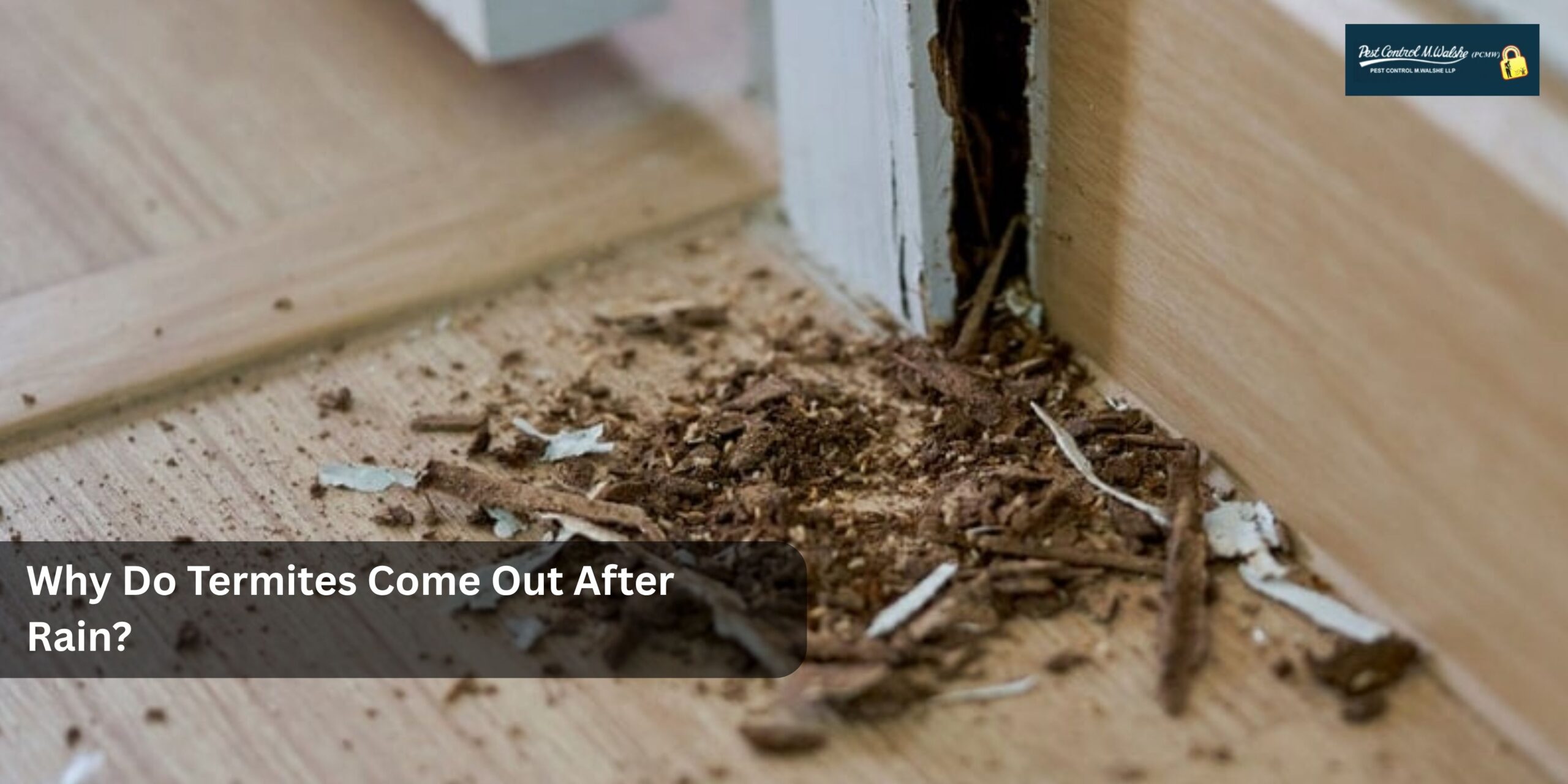
Winged termites after rain shedding their wings on your windowsill or near a door frame is one of the clearest early signs of termite damage, even if you never see the colony itself.
Once swarmers land and find a mate, they break off their wings almost immediately, since they no longer need to fly. Finding a small pile of discarded wings, roughly uniform in size, near an entry point tells you two things: a swarm happened recently, and it happened close to that exact spot.
This is different from spotting one or two stray insects. A cluster of shed wings means the colony triggering the swarm is likely inside your walls, under your flooring, or in the soil right next to your foundation.
Termites are often compared to icebergs for a reason. What you see on the surface, whether that’s a swarm or a pile of wings, is a small fraction of the colony working through wood and cellulose out of sight.
What Should You Do When You Spot Termite Activity After Rain?
Termite activity after rain calls for an inspection within the same week, not a wait-and-watch approach. Colonies don’t slow down between rain events, they just become less visible.
Steps worth taking right away:
- Note exactly where you saw the swarm or found discarded wings. This location detail helps a technician find the colony faster.
- Check nearby wood, door frames, skirting boards, and furniture for hollow-sounding spots or blistered paint.
- Avoid spraying random insecticide on the swarm itself. It kills visible insects but does nothing to the colony feeding your home from below.
- Book a professional inspection instead of a DIY spray-and-hope approach, especially if this is the second or third season you’ve noticed swarms in the same spot.
Termite damage rarely announces itself loudly. A swarm after rain is often the loudest warning you’ll get before the damage becomes structural.
How PCMW Handles Post-Monsoon Termite Infestations
Pest Control M WALSHE LLP has run termite treatment programs across Indian homes and commercial properties since 1956, and monsoon season is consistently the busiest stretch of the year for swarm-related callouts.
The approach starts with locating the colony, not just treating the visible swarm. Technicians check for mud tubes, soil moisture near the foundation, and hollow wood before recommending a treatment plan. Depending on whether the property is pre-construction or already built, treatment involves either injecting termiticide under the slab before flooring goes in, or drilling and treating at an angle around the existing structure.
PCMW is also India’s first ISO 9001 certified pest control and fumigation company, and works on a “No Cure, No Pay” basis, meaning the treatment is built around actually resolving the infestation rather than a one-time spray. For homes that have dealt with repeat swarms across multiple monsoon seasons, longer-term guarantee plans covering one, three, or five years are available.
If you’ve spotted a swarm or found wings near a doorway, termite pest control services from PCMW start with a proper inspection, not a guess.
FAQ
Do termites only swarm after rain, or can it happen any other time?
Rain is the most common trigger, but warm, humid weather without rain can occasionally produce a swarm too. Rain simply softens the soil enough for swarmers to exit easily, which is why it lines up with the swarming season so closely.
If I see a termite swarm, does that mean my house already has termites?
Not necessarily your house specifically, but it almost always means a colony is active somewhere close by, often within your yard or a neighboring property. It’s worth an inspection either way.
How long does a termite swarm usually last?
Most swarms are over within 30 to 40 minutes. Some finish in under 15. If you miss it, discarded wings on the ground are the next best clue.
Can I just vacuum up the swarmers and ignore it?
You can clean up the swarm itself, but that does nothing to the colony that produced it. The swarmers dying or being removed doesn’t stop the underground colony from continuing to grow.
Is it normal to see termite swarms every single monsoon season?
Repeated swarms in the same spot, year after year, usually mean the colony hasn’t been treated. A single treated property shouldn’t keep producing swarms season after season.
Spotted Termites After Rain?
Don’t ignore termite activity after rainfall. A professional inspection
can help identify hidden termite activity and protect your property
from costly damage.
Conclusion
That cloud of insects near the porch light after a monsoon downpour isn’t bad luck. It’s a colony that’s been growing quietly for years, finally sending out signals you can actually see.
Termite activity after rain is the easiest window you’ll get to catch an infestation before it reaches the structural stage. Pest Control M WALSHE LLP has spent close to seven decades reading exactly this kind of signal. Get in touch with PCMW today for an inspection before the next rain brings another swarm to your door.